
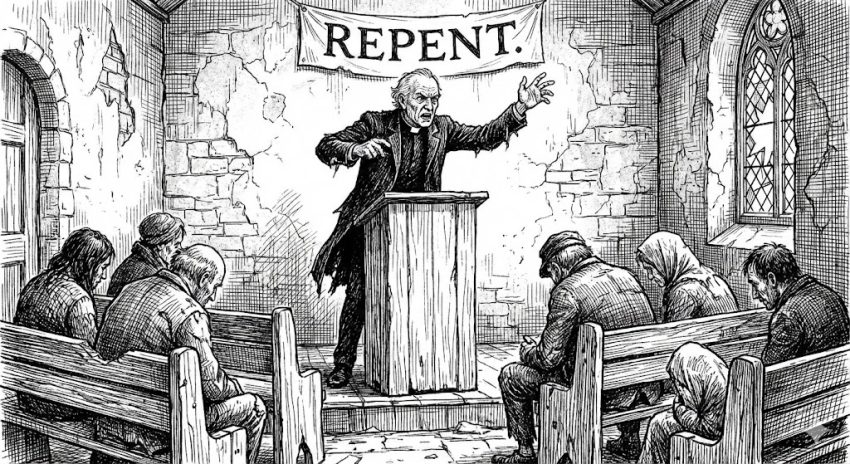
Number 17 Nether Oak Close had long been the residence of Reverend Samuel Wilson, a firebrand preacher known for his white, towering, blue-eyed Jesus and a theology built on punishment, torment, and eternal fire. His congregation had dwindled, young families preferred gentler teachings, and some even dared explore other faiths, which Samuel considered worse than atheism.
He lived with his wife in a cold, silent marriage, their childlessness born not of biology but of Samuel’s fear he might enjoy marital relations. She had long ago learned that in her husband’s world, she was to be seen, not heard.
On this morning, Samuel sat hunched over his desk preparing his next sermon, hunting for the sharpest word for transgressions. He paused to look out the window and saw the children from Number 16 heading into the copse, the eldest clutching a book. “All destined for an eternity of pain if I am not mistaken,” he muttered. He scribbled “Desecration of God’s Grace” into his notes and added, “Children only need one book, and I warrant the one that little sinner has in her hands is NOT it.”
A soft cough sounded behind him.
Startled, Samuel rose, spinning on his heel.
A small man sat calmly in the armchair by the bookcase, a stranger with dark curly hair, a full beard, ragged clothes, and sandals. To Samuel he looked like one of those refugees arriving on dinghies, very probably a “Moooslim.”
“Who are you? How did you get in?” Samuel roared. “Whatever you want, I WANT none of it! You look like a worthless heathen!”
He flung open the door, hoping the man would take the hint.
The stranger merely looked up with a serene little smile.
“Samuel, Samuel… is that any way to speak to a stranger in your land?”
Samuel froze.
Leviticus 19:33–34. The book he preached often, though never that verse, he preferred the “Abomination” ones.
The stranger continued, “Let me introduce myself. I am Chaim Nabulsi, and I am here to help you.”
“HELP? I need no help from the likes of YOU!” Samuel thundered, flecks of spit flying. Chaim wiped them away with a handkerchief pulled from his robe, still smiling.
Samuel slammed the study door behind him, storming into the hallway. But before he could work himself back into righteous fury, there came three small, rapid taps at the front door.
No one knocked on his door unless desperate.
He opened the door, posture rigid—and looked down at Paul the smallest of the children from Number 16, blotchy-faced and trembling.
“P–P–Preacher Wilson… I can’t find Sarah or Millie or Mam or Da I looked and looked and.. and the copse is dark and it’s making noises and I…I…I didn’t know where else to go.”
Samuel opened his mouth to chastise the child for wandering, for disturbing him, for something, but nothing came.
“Are my parents in hell?” Paul whispered.
The question gutted him.
“N–no!” Samuel blurted. “Certainly not! Children shouldn’t…. that is not…. He stammered, flailing for the first time in memory.
Paul hiccupped. “Sarah said you told her that sinners go to the fire. Sometimes Mam says bad words. Dad stole a biscuit. I don’t want them to burn forever…”
Samuel felt a hot wave of shame.
This is what they learned from me.
He crouched, knees popping, until he was level with the frightened child.
“Paul,” he said quietly, “your family is not in hell.”
“But… how do you know?”
The old answer, fire, wrath, punishment, died unspoken, on his tongue.
“I know,” Samuel said slowly, “because God does not delight in hurting people.”
The words startled him. They felt new. Soft. Real.
Paul whimpered once, then threw his arms around Samuel’s torso, pressing his face into the preacher’s coat. Samuel stiffened, no child had ever hugged him before, but after a moment he placed a trembling hand on the boy’s back.
“It’s all right,” Samuel whispered. “You’re safe. We’ll find them.”
He did not notice Chaim standing in the hallway behind him again, smiling gently.
They found the family easily, in the driveway of Number 3, deep in discussion with Michael about mysteriously full bins. Ordinary things. Comfortable things.
Paul’s mother shrieked with relief when she saw him.
“Oh sweetheart! What the matter? ”, she wiped an old tear from Paul’s cheek.
His father hugged him; Hugh and Margaret fussed; warmth swarmed around him like sunlight.
Michael nodded at Samuel. “Good man, Reverend. Thank you.”
Paul whispered loudly to his mother, “Preacher Wilson helped me.”
Their grateful eyes turned to Samuel.
He gave a stiff nod, unable to speak.
And as the reunited family wrapped Little Paul in comfort, Samuel felt something shift inside him, something that had been locked away for many, many years.
He walked back to Number 17 slowly, replaying the simple, effortless love he had witnessed. The easy touch, the instinctive comfort, the warmth.
He could not remember the last time his wife had touched him.
Or he her.
Inside, she was preparing lunch in silence, slicing carrots with mechanical precision. When she glanced up, she gave a tiny nod, the conditioned gesture of someone who had learned to remain small.
Samuel watched her, feeling a tightness in his throat.
“Maud,” he said.
She froze.
Samuel stepped closer and, heart hammering, took her hand in his.
She gasped softly.
“I am sorry,” he whispered. “For how I have lived. For how I have treated you. I… I have been wrong.”
Margaret stared at him, bewildered.
Then, slowly, uncertainly, she squeezed his hand back.
It was the smallest gesture.
For them, it was seismic.
The next Sunday, Samuel’s church was sparsely filled, as usual. But whispers rose when Samuel opened his Bible not to judgment or condemnation—but to Matthew 5.
The Beatitudes.
Words he had never touched.
He cleared his throat.
“‘Blessed are the poor in spirit,’” he read, voice trembling.
“For years I believed these words were too soft. Too forgiving. Not strong enough to hold back the tide of sin.”
A ripple passed through the pews.
“But I was wrong. These words are not weakness. They are the heart of strength. A strength I have lacked.”
He looked up, eyes shining.
“I have preached fear. I have burdened souls rather than lifted them. And today… I begin again.”
After the service, Samuel found Chaim sitting in the last pew, as though waiting patiently for the moment to come.
“Who are you?” Samuel asked quietly.
Chaim’s smile was soft, sad, luminous.
“A Palestinian Jew,” he said. “Once full of rage. I grew up under occupation. I believed hatred was holy. I wanted my enemies destroyed.”
Samuel swallowed.
“One day, beside a well, I heard a Nazarene speaking,” Chaim continued. “A carpenter’s son.”
His hand pressed to his chest.
“His words broke my hatred open. He spoke of loving enemies. Of seeing God even in those we fear.”
He met Samuel’s eyes.
“So I have given my eternity to helping others find what he taught me: how to love.”
Samuel’s breath shook.
“Teach me,” he whispered.
Chaim smiled gently.
“I already have.”
And with that, he rose and walked away, leaving Reverend Samuel Wilson standing in the soft glow of the sanctuary, a man remade by a frightened child, a gentle stranger, and a love he had spent a lifetime preaching against.
But was finally learning to understand.
Dug it, thank you. Like the characters, and the moral.