
Kate MacHugh lived in Number Five, Nether Oak Close, the house up beside the post-box and the bus stop. It was a clean, square little place, pebble-dashed and neat, the sort of house where things had their assigned places and where those things stayed. Inside, the order sharpened into something close to ritual. Her hallway smelled faintly of lavender polish. Her wardrobe was colour-coordinated to an almost monastic degree. Every surface shimmered with care.
And in this house, mirrors multiplied like rabbits.
Small ones for eyeliner. Tall ones for outfit checks. Wide, bevel-edged ones catching morning light. A Venetian-framed one that had cost more than she would ever admit to her accountant. Mirrors on walls, on dressing tables, in corners where they reflected one another in infinite regress. Her house didn’t simply contain mirrors, it curated them.
Kate was the senior editor of Vibrant You! Northern Ireland’s leading magazine for the middle-aged woman with aspirations, aspirations to look well-rested, to stay intimate with her spouse, to glow, to stay relevant, to aspire to whatever the denizens of Cultra thought was “just right”. She had spent twenty years trimming, titivating, and tastefully reframing the world into something smoother than reality. And without ever deciding to, she had begun trimming and reframing herself in the same way.
The morning it began was perfectly normal.
Her alarm played the cheerful synth chime she had chosen three years ago. She showered, blow-dried her hair, applied her makeup with swift practised strokes. Mascara, eyeliner, light blush, she kept it subtle these days. Tastefully ageless.
Breakfast was muesli with a dash of milk; eaten from the Louis Mulcahy Raku bowl she’d bought on that Dingle photo shoot. Chris and Sarah on Good Morning Ulster were grilling a TUV politician who was avoiding their questions with the slippery elegance of a trout. Kate sighed. Sometimes she wished she lived anywhere but Northern Ireland.
She washed the bowl, left it on the draining board, and grabbed her bag and keys.
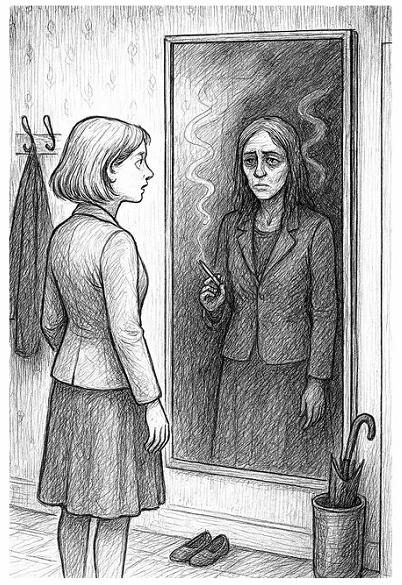
The last step of her routine, her ritual, was always the same. She paused in the hallway and looked into the full-length mirror beside the coat hooks.
Hair: check.
Makeup: check.
Jewellery: check.
Accessories: check.
Presentable. Polished. Correct.
She turned to go.
And out of the corner of her eye she saw her reflection still standing face-on in the mirror, shoulders slumping with what looked overwhelmingly like resignation.
Kate spun back. The reflection behaved normally again, mirroring her movements precisely.
She stared for a moment. Blinked.
“Not enough coffee,” she muttered, and left for work.
By the time she reached the office, she had dismissed it entirely.
When she returned that evening, the mirror incident was forgotten. She hung her coat on the hook, brushed a stray hair from her collar, and walked toward the kitchen.
It was only when she glanced, automatically, into the hallway mirror that she froze.
She wasn’t there.
Her coat, the hall table, the umbrella stand, reflected perfectly. But Kate herself had no reflection at all.
Her pulse spiked. She took a cautious step toward the glass. As the angle shifted, she caught a glimpse,not of the hall, but of the living room beyond it.
Her reflection, her other self, sat on the sofa, back turned, a thin curl of smoke drifting upward from her hand.
Kate choked.
“But I quit smoking ten years ago.”
The reflected figure on the sofa took a long drag, exhaled, and the ashtray glowed faintly red.
“What the hell,” Kate whispered.
The image blinked out. Her own reflection popped back into place, showing a pale woman with wide startled eyes.
Kate backed away. “No. No. No.”
She waited for dizziness, for a headache, for some sign she was losing touch with reality. It didn’t come.
The mirror stayed ordinary. The house stayed quiet.
But that night, turning off the lights, she felt a prickle on the back of her neck.
As though someone was standing just inside the glass, watching her.
The next evening, it escalated.
She stepped into the hall, tired, hungry, irritated by a vapid article she’d spent the afternoon salvaging.
“Five Ways to Be Radiant at Any Age.”
God help her.
She walked past the mirror. Once again, no reflection.
This time she didn’t hesitate.
“Right,” she said, planting herself in front of the glass. “I’m sick of this.”
Her voice echoed down the hallway. The mirror surface rippled like water stirred by a stone.
Her reflection appeared slowly, deliberately, and stared at her. The reflection’s eyes were sharp and older than they should have been.
Kate swallowed.
“What do you want from me?”
The reflection sighed. A real, audible sigh.
“At last,” it said. “You’re paying attention.”
The voice didn’t echo from the house.
It echoed from the mirror.
Kate staggered back. “What…what are you?”
The reflection unfolded its arms. It moved with the casual confidence of someone who had never once doubted their place in the world.
“I am called many things,” it said. “But you may know me as Badh.”
Kate frowned. “The bird woman? The crow? The Irish goddess?”
“Aspect of,” the reflection corrected lightly. “Insight. Foreknowledge. Truth. The new broom that sweeps cleaner than the old.” She smiled thinly. “And god knows you need a bit of a clean up, Kate MacHugh.”
Kate bristled. “I beg your pardon?”
“You shouldn’t.”
The reflection tapped the glass.
“You’ve built a life out of surfaces. Obsessed with looking like yourself. You’ve long forgotten how to be yourself.”
Kate’s throat tightened. “That’s not true.”
“Isn’t it?” the reflection said. “Let’s have a look.”
The mirror image dissolved.
In its place she saw herself at twenty-five, smoking on the fire escape of her first magazine job, hair wild, eyes bright with ideas, ranting passionately about how women deserved better than anti-ageing drivel.
“She was brilliant,” Badh said. “And you’ve spent twenty years suffocating her.”
The image shifted, now Kate at forty, sitting on the edge of a bathtub, mascara streaked, heart newly broken. Writing through the pain. Writing with a raw, startling honesty.
“You used to tell the truth,” Badh murmured. “Even when it hurt.”
Then the mirror went black.
Empty.
Nothing reflected. No hall. No Kate.
“This,” said Badh, “is where you’re heading. A sleek, hollow thing. Efficient. Silent. A woman who edits herself out of her own life.”
Kate’s knees weakened. She clutched the wall.
“Why are you showing me this?”
“Because you’ve stopped listening to smaller warnings.”
A pause.
“Because inspiration, true inspiration, is not pretty. And you have been trying to peel away everything in yourself that isn’t.”
Kate pressed a shaking hand to her forehead. “I don’t know who I am anymore.”
“Good,” Badh said. “Then there’s space to find out.”
Over the next week, the mirrors would not leave her alone.
In the morning, she saw herself at her desk, staring at a blank page with furious determination.
In the evening, she saw herself dancing in a bar in Portstewart, she barely remembered being young enough to enter. Late at night, she saw no one at all.
At work she found herself rewriting articles in tones that made her colleagues blink.
Her version of “5 Ways to Stay Youthful” began:
Stop pretending you’re not ageing.
You are.
You’re not a peach. You’re not meant to stay firm forever.
Her editor-in-chief hated it.
The junior staff whispered, excited.
Her inbox filled with readers who said, “Thank you. Someone finally said it.”
Something cracked inside her, something brittle, something long overdue.
One evening she stood again before the mirror.
She was exhausted, but not the dull kind of exhaustion that came from sameness.
The good kind, creative fatigue, a draining of emotional honesty.
Her reflection looked back at her with something like approval.
Kate asked, quietly, “Why me? I’m not a hero. I’m just… stuck.”
Badh tilted her head.
“You mortals think I visit only the desperate. Only the doomed. But stagnation, stagnation is a kind of death. And I am here to clear that away.”
Kate swallowed. “So what now?”
“That depends on you,” Badh said. “You can return to your polished cage. Or you can open the door.”
The mirror calmed. The surface went still.
When Kate blinked, her reflection looked exactly like her again, tired, makeup smudged, scarf askew.
But she didn’t correct any of it.
The next morning, she took down the mirror in her bedroom.
A week later, she removed three more.
By the end of the month, she stood in the hallway, coat in hand and walked past the full-length mirror without looking into it at all.
The glass stayed clear.
No goddess spoke.
But on the hall table sat a single black feather, glossy and iridescent in the morning light.
Kate touched it with the tips of her fingers.
Then she picked up her keys, stepped out into the day, and for the first time in years, felt entirely like herself and was ready for the day.